Skip to content

Publications

ELN publications feature authoritative research, high-quality analysis, diverse viewpoints and practical recommendations to address current foreign, defence, and security policy challenges.

Filter

Content type

Topics

Programmes

Year

Multimedia type

639 items
Page 1 of 71
Commentary

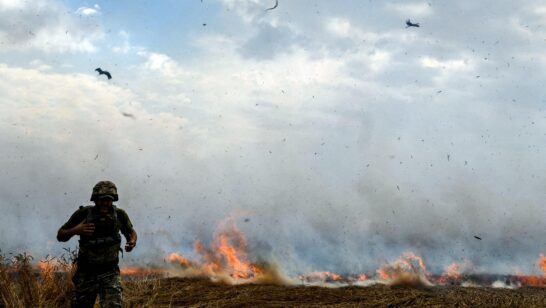
Climate action needs a peace dividend: why COP31 must address the environmental costs of war

Climate diplomacy has largely avoided confronting the environmental costs of war. Yet armed conflicts generate enormous emissions, destroy ecosystems and infrastructure, and divert resources from decarbonisation. As COP31 convenes, governments must recognise the relationship between militarism and climate change, and bring the consequences of armed conflict into climate negotiations.

10 November 2026 | Nikita Gryazin
Commentary

The OPCW’s funding crisis is a threat to global security

With the United States withholding its financial contribution to the OPCW, the organisation faces a funding crisis that threatens its vital work. Former Director-General Ahmet Üzümcü argues that the OPCW has repeatedly demonstrated its competence and ability to adapt to changing circumstances, and urges Washington and other states parties in arrears to fulfil their financial obligations.

13 October 2026 | Ahmet Üzümcü
Podcast

Ok, Doomer! podcast: 30 years of the nuclear test ban

In our latest episode, we look at what the Comprehensive Nuclear-Test-Ban Treaty (CTBT) has achieved over the past three decades, why it remains an important part of the global nuclear order despite never entering into force, and the challenges it faces today. Hosted by the ELN’s Deputy Executive Director Bekki Field and ELN Policy Fellow Dr Jana Baldus.

Commentary

The IAEA’s fading ‘Vienna Spirit’: Can consensus survive?

The IAEA’s annual General Conference meetings have grown successively more contentious in recent years. Geopolitical tensions outside the Agency are increasingly corroding the insulation around the IAEA’s technical work. Noah Mayhew asks: Is the “Vienna Spirit” dead? At the GC, it may not be dead, but it is certainly on life support – and the IAEA’s mission will ultimately bear the cost.

16 September 2026 | Noah Mayhew
Commentary

What Russia’s wartime Duma election means for the Kremlin

Russia’s upcoming Duma election will be the first since the full-scale invasion of Ukraine. In an unfavourable context, the Kremlin’s political managers have been highly active in sterilising the ballot. Anton Barbashin, Editorial Director of Riddle Russia, examines how these wartime elections are becoming a demonstration of support for the war and Putin’s continued rule.

15 September 2026 | Anton Barbashin
Commentary

A managed result, but not a meaningless one: Reflections ahead of Russia’s Duma election

Russia’s elections may be repressive and predictable, but that does not make them meaningless. While no one predicts that United Russia will be denied a majority in the upcoming Duma election, managing the political space has become more difficult than in the past. As Julian G. Waller writes, deviation from the Kremlin’s desired result could have wider consequences for elite politics.

7 September 2026 | Julian G. Waller
Event

Three Strikes and We’re Out? What’s Next for the NPT Review Process

Ambassador Đỗ Hùng Việt, Vietnam’s Permanent Representative to the United Nations, New York, and President of the 2026 NPT Review Conference, reflects candidly on the 2026 NPT Review Conference’s collapse without consensus: What was achieved, what broke it, and what comes next. In conversation with the ELN’s Oliver Meier and Jana Baldus.

25 August 2026
Podcast

Ok, Doomer! podcast: What’s next for the nuclear non-proliferation treaty?

In our latest episode of the Ok, Doomer! podcast, we ask what comes next for the Non-Proliferation Treaty, featuring a range of distinguished guests including UN Under-Secretary-General Izumi Nakamitsu, Ambassador Alexander Kmentt, and Thomas Countryman. Plus, a deep dive into the review process with more nuclear policy experts.

Commentary

Burnham’s Britain: Continuity, defence, and a new industrial strategy?

Former UK Labour MP Madeleine Moon argues that Britain’s political instability is the product of profound social and geopolitical change. With Andy Burnham in Number 10, Britain must think simultaneously about defence, the economy, technological advantage, and democratic institutions while building on reforms to pursue a whole-of-society approach to national resilience.

4 August 2026 | Madeleine Moon