
Europe’s security architecture lies in ruins. A new one must be designed before it can be built.
The transatlantic partnership is fraying. Current EU security policy resembles a farce. And much of the legal framework that for decades underlay European security has been dismantled or rendered ineffective: the Intermediate-Range Nuclear Forces (INF) Treaty on intermediate-range missiles is gone; the START framework governing US and Russian strategic nuclear weapons has largely unravelled; the Treaty on Conventional Armed Forces in Europe (CFE) has collapsed; and both the Open Skies Treaty and the NATO–Russia Founding Act have lost their practical significance.
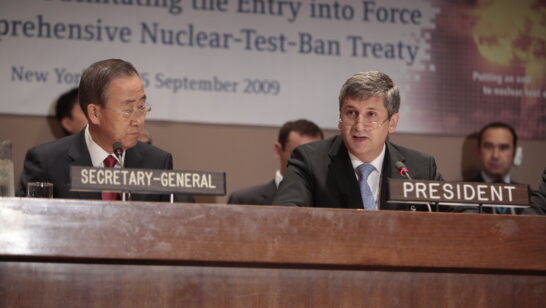
One of the few institutions to survive the past decade’s erosion of international security agreements is the Comprehensive Nuclear-Test-Ban Treaty (CTBT) – the agreement banning nuclear test explosions in all environments.
What can the test-ban regime teach us about building a new European security architecture for the time when, eventually, the guns fall silent in Ukraine?
The CTBT was adopted by the UN General Assembly in September 1996 – exactly 30 years ago today. But the groundwork for a comprehensive ban had begun decades earlier. It began with the 1958 Geneva Conference of Experts to Study the Possibility of Detecting Violations of a Possible Agreement on the Suspension of Nuclear Tests, which led states to invest heavily in the development of a technical support system for a total ban.
The investment paid off. By the time decision-makers in Moscow, Paris, and Washington were finally ready to agree to a comprehensive ban on nuclear testing, much of the technical basis for a verification system was already in place. Diplomats could strike while the iron was hot.
The treaty’s basic logic is simple. Nuclear testing fuels arms competition and carries serious humanitarian and environmental costs. Nuclear explosions are therefore prohibited. To enforce that prohibition a global monitoring system continuously searches for possible violations. A worldwide network of stations sends data to an international data centre in Vienna, where it is analysed before both raw data and analytical products are made available to member states.
The comprehensive test-ban regime helped defuse one of the Cold War’s most contentious security disputes. For decades, nuclear testing had generated major diplomatic crises, public protests, and political confrontation. Today, nuclear test explosions are exceedingly rare and carry a heavy international stigma.
Crucially, the system does not depend on states trusting one another.
When a suspicious event occurs, governments do not have to rely solely on secret intelligence or on the claims of a single state. They have access to a shared body of measurements that can be analysed and independently scrutinised. Broad access to evidence narrows the space for disinformation, misunderstanding, and the kind of worst-case thinking that helped drive the Cold War arms race.
That points to the first of several possible lessons.
The next generation of European security arrangements cannot be built on good intentions or good faith agreements. They must be designed for a world in which states often assume the worst about one another – frequently with good reason.
The next generation of European security arrangements cannot be built on good intentions or good faith agreements Kjølv Egeland
A second lesson is that security institutions are more resilient when they serve several purposes. The test-ban regime is strengthened by the fact that the sensors developed and deployed to detect nuclear explosions also contribute to earthquake research, tsunami warning, and emergency preparedness. Institutions that provide wider benefits are easier to sustain politically and financially – though, admittedly, the test-ban regime is under increasing financial strain.
A third lesson is that waiting for universal agreement can sometimes become an excuse for doing nothing. The Comprehensive Nuclear-Test-Ban Treaty was adopted by a majority vote at the UN after it was blocked in the Conference on Disarmament in Geneva. The treaty has still never formally entered into force. Yet the norm against nuclear testing has become deeply embedded, and the verification system is operational.
Fourth, future verification arrangements should, wherever possible, be grounded in shared data and independently testable evidence. Technology cannot replace politics. But when disagreements arise, shared evidence provides a better starting point than competing claims about whom to believe.
The final and perhaps most important lesson is that institutions often cannot be improvised the moment a political opening suddenly appears.
The CTBT verification system rests on decades of research, technological development, and international cooperation. The same will be true of future European security arrangements – be it ceasefire monitoring in Ukraine, arms control in Europe, or military transparency more broadly.
Research programmes, pilot projects, verification technologies, and institutional models must be developed well in advance, so that technical solutions are oven ready when political windows of opportunity open.
European leaders have spoken loudly about the need for a new European security architecture. The phrase is easy to invoke. Building one will be harder. The work should begin now.
The European Leadership Network itself as an institution holds no formal policy positions. The opinions articulated above represent the views of the authors rather than the European Leadership Network or its members. The ELN aims to encourage debates that will help develop Europe’s capacity to address the pressing foreign, defence, and security policy challenges of our time, to further its charitable purposes.
Image credit: US Department of State from United States / Wikimedia Commons